Dreidel (Music Twist)

Yesterday was the first day of Hanukkah. None of my students are Jewish (nor am I), so I thought it was unlikely that any of them had ever played dreidel before (nor had I). My total knowledge of the game comes from My Jewish Learning. We used it to drill rhythms, but as always, it is easily modifiable to drill anything else.

What you need:

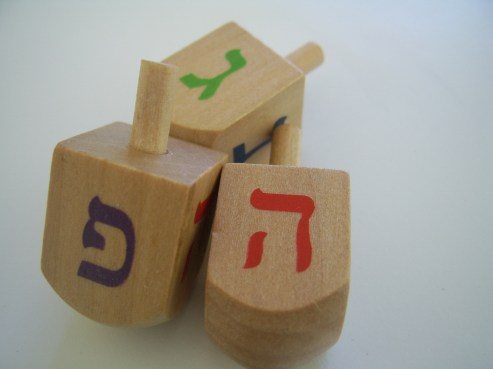
  • A dreidel.
    • These are not expensive. Think Oriental Trading Company, Amazon, etc.
  • Cards with whatever you want to drill. I used rhythm cards.
  • Game tokens of any kind.
    • Mine are from the game Reversi, but you could also use pennies, pencil erasers, small chocolates, whatever.
  • Paper and pencil (optional)

Setup:

  • Distribute tokens evenly between the players. I went with six each, but the actual amount doesn’t matter much. Add some to a center pile as well. I put four in.

How to Play:

  • The first player spins the dreidel. There are four possible outcomes:
    • ש – The player adds a token to the center pile, and count and clap a rhythm on from the stack of flashcards.
    • ח – The player gets half the tokens in the center pile and must invent a rhythm, write it out, and count and clap it.
    • ב – The player gets all the tokens in the center pile and must write out a rhythm that the other player claps.
    • נ – The player does nothing.
  • When the lesson time is over, the person with the most tokens wins.


If you thought through the statistics, you’ll have noticed that the odds are overwhelmingly in favor of having an empty center pile. Plus it’s all random chance, and I always like to make sure my students win, so here are a few tips:

  • Sometimes I make a mistake in my counting and clapping. If the student can catch me and do it right, they get the tokens I was supposed to collect. If I was supposed to add a token to the pile, I have to add double. I used this strategically whenever I was supposed to get a fair number of tokens.
  • When the center pile has been empty for a couple of turns, it gets boring. A couple of times, I just told the student I was going to cheat and add a few more tokens to the center pile. I did not tell them that I only did that when it was their turn. That increases the likelihood that they end up with those tokens, not me.


dreidels-20347_1920


Turkey Feathers (How to Drill Anything)

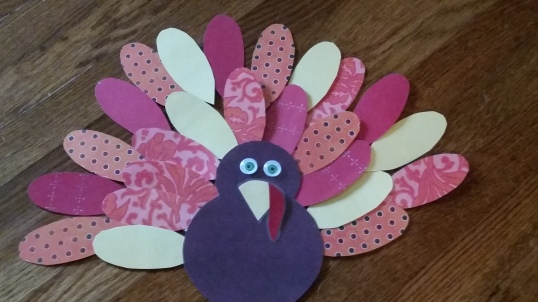
There is nothing better than using the same materials you already created for a new purpose. My Thanksgiving turkey from Pluck the Turkey (Note Review) is a multi-purpose turkey for drilling other things as well.

What You Need:

  • A turkey body, plus a lot of feathers
    • I cut mine out of scrapbooking paper so they were already in cute patterns with no extra effort on my part.
    • If you want to be able to reuse it for multiple purposes, laminate everything. Otherwise, don’t bother.
  • Tape or sticky tack

Setup:

  • Write on the back of the feathers what you want to drill, such as:
    • Phrase 1, Phrase 2, Phrase 3, OR
    • Review Song, Recital Song, Sightreading, OR
    • Rhythms to clap back OR
    • write absolutely nothing and just draw a card from a stack of flashcards when necessary.
  • Hide the feathers around the room or don’t bother and just put them in a heap next to your turkey body.

How to Play:

  • The student finds a feather if they are hidden or just choose one if they’re not.
  • Do whatever is on the flashcard.
  • Tape or sticky tack the feather on the turkey body to make your turkey resplendent.
  • Repeat.

20171106_071908

For Health and Strength (Learn by Rote)

Certain of my students are really struggling with developing an ear, so a simple song that can lead to success without a lot of tears along the way is a good thing.

“For Health and Strength” is a traditional song, which is appropriate for Thanksgiving, fairly well known, and easy to learn, so it ticked all the boxes for ear training this month, and every one of my students picked it up pretty quickly, following this method:

  • Place the hands in middle C position.
  • Starting in the right hand, play four notes, three of which are the same:
    • G G G F
  • Then play the same pattern, but start on E:
    • E E E D
  • Play the same pattern again, but start on C:
    • C C C B
  • Start at the top and play the whole sequence:
    • G G G F   E E E D   C C C B
  • Our song doesn’t sound finished until we add a long home note at the end:
    • G G G F   E E E D   C C C B   C
  • The last thing we add is the pickup note at the beginning. It’s a low G. So our final sequence is:
    • G (low)  G G G F   E E E D   C C C B   C


Once they knew the basic song, we did a number of things depending on interest and ability level:

  • Play it in a round.
  • Transpose
  • Play it with duet accompaniment in various styles.
  • Create a variation in the melody by shaking up the rhythm or articulation or dynamics or making it minor.

Alternatively, you could also use this fakebook version to practice a different skill set with the same song.

thanksgiving-2903166_1280


Pluck the Turkey (Note Review)

What You Need:

  • A turkey body, plus a lot of feathers
    • I cut mine out of scrapbooking paper so they were already in cute patterns.
    • If you want to be able to reuse it for multiple purposes, laminate everything. Otherwise, don’t bother.
  • Flashcards with the notes of the staff.
  • Some kind of timer (only needed for version 2)

Setup:

  • Write on the back of the feathers. (Use a whiteboard marker if you laminated.)
    • About three should say “Teacher Loses a Turn”
    • About three should say “Freebie”
    • Half of the rest should say “N” for name the note.
    • All of the rest should say “P” for play the note.
  • Lay out your turkey on the floor.


How to Play (Version 1, the competitive way):

  • The first player plucks a feather from the turkey and draws a note flashcard.
    • If the feather says “N,” the player should name the note on the flashcard.
    • If it says “P,” the player should play the note on the piano.
    • If it says “Freebie,” they get the feather for free.
  • Take turns until the turkey is completely plucked. Count the feathers to see who has the most.
    • The teacher loses a turn cards guarantee that the student will always have more. None of my kids picked up on this.

How to Play (Version 2, the timed way):

  • With input from the student, determine how long the student will need to completely pluck the turkey. (The amount of time varied from 1 to 5 minutes, depending on the level of the student and the number of feathers on the turkey.)
  • When the timer starts, the student plucks one feather at a time and plays or names the note. In this version, the teacher loses a turn feathers are just like a freebie feather.
    • (Occasionally, I surreptitiously stop the timer while they aren’t looking to make sure they finish in time.)

20171106_071908

Halloween Practice

I always like being able to make one set of materials and use it in multiple ways. Most of my kids used these Halloween cards to compose a rondo, but one lucky girl also used it to work on her current songs.

What You Need:

  • These Halloween cards, printed and cut (you won’t need the second page)
  • Dice
  • A mini pumpkin or anything else you can use as a playing piece
  • A list of Halloween jokes. I have a little book of jokes, but you could also use these, either printed out or just available on a device.

Setup:

  • Make a list of the pictures on the cards and assign them to things you need to practice. It’s okay to repeat, it’s okay not to use all the cards, and it’s good to include a few things in there that are more exciting. For example, here’s a sample list:
    • moon: current song, section A
    • raven: current song, section B
    • haunted house: current song, hardest phrase
    • jack o’lantern: current song, hardest phrase
    • skeleton: current song, hardest phrase
    • bat: review song
    • trick or treat bag: review song
    • cat: current scale or arpeggio
    • witch: current scale or arpeggio
    • spider: next step in the composition book
    • skeleton: Halloween improv duet
    • mummy: sing a Halloween song
    • ghost: sight read
  • Arrange the cards face down in a circle on the floor and place the pumpkin or playing piece on one of them.
  • Hide the jokes so the student can’t see them all at once.

How to Play:

  • Roll the dice. Advance the pumpkin that many cards, moving clockwise.
  • Flip the card. Spend a couple of minutes practicing whatever goes with that picture.
  • Keep the card just as it is and roll again, continuing the same pattern.
  • If you land on a card which has already been flipped over, you have earned a Halloween joke. Conveniently, the likelihood of getting a joke increases the longer you play.

20171031_085759.jpg