Motif Game

A musical motif is a device that most of my students don’t arrive at naturally. It needs explanation, and here is a great way to do it.

What You Need:

  • These cards, printed and cut up
  • A die
  • Game Pieces

Setup:

  • Remove any cards you don’t want to use.
  • Starting with “Start,” lay the cards out face down on the floor like a board game. You can make loops and swirls and short cuts to make it more interesting. End with the “Finish” card.
  • Place your two game pieces on Start.

How to Play:

  • First explain the concept of a motif.
    • A motif is a very short musical idea. (Two measures maximum for this game.)
    • For example, the first line of “Twinkle, Twinkle,” the first measure of the “Imperial March” from Star Wars, the first four notes of Beethoven’s 5th symphony, etc.
    • Our ears like repetition, but they also get bored. Composers use motifs to create melodies by modifying their motif just enough that it stays interesting, but not so much that we can’t identify it as the same motif.
  • Both the student and the teacher need to come up with a motif in the key of C major. Keep it simple. Make the student play their idea several times until they can remember it consistently. When he can reliably play it back, he’s ready to play.
  • The student rolls the die and advances his game piece that many cards forward. Then he needs to return to the piano and play his same motif, but with the modifications specified on the card (i.e., with a different key, tempo, rhythm, etc.)
    • Some modifications are easier than others. You can keep score by assigning points for difficulty. Or you can ignore scores and just play to see who gets to finish first.
  • The teacher takes a turn with her own motif.
  • The first one to the finish line wins. (Or the one who collects the most difficulty points wins, if you are playing with points.)


Variations:

  • To make it easier, only place out the easiest cards, such as dynamic changes and changing one note.
  • To make it harder, remove the easier cards, such as dynamic changes and changing one note.
  • To make it spookier, create your motif in A minor and remove all the cards that have major key signatures.
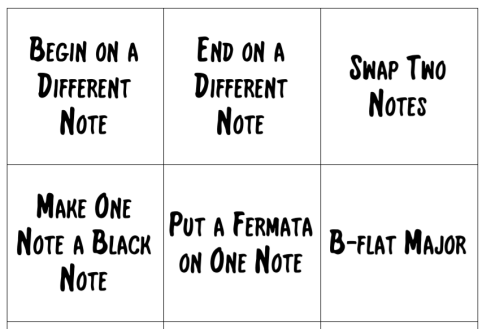
Motif Game


Poison Rhythm Game

Poison Rhythm Game


The poison rhythm game is commonly done in group settings, but here is an adaptation for a private lesson.

What You Need:

  • Paper
  • Writing utensil
  • Drums or other percussion instruments (optional)

Setup:

  • None

How to Play:

  • Write out one measure of rhythm in 4/4 time and place it where both players can see it. This is the poison rhythm.
  • The teacher plays a measure in 4/4 time (not the poison rhythm). If you’re not using instruments, just clap the rhythm. The student should listen carefully and play or clap it back.
  • Repeat the call and response rhythms as many times as you like.
  • At some point, the teacher should play the poison rhythm. The student should NOT play back the poison rhythm. If they stop and do nothing, they have earned a point. If they are not paying attention and do play it back, the teacher earns a point.
  • Write a new poison rhythm and go again. The game ends whenever you run out of time.

Variations:

  • To make it easier, use only basic rhythms, count out loud, and give the student multiple chances to play back each rhythm.
  • To make it harder, use more complicated rhythms or make each rhythm two measures long.
  • To make it more creative, switch roles so that the student is generating all the rhythms.


The Slap Game (Note Review)

This is a great game to play when you’ve just got a few minutes left in the lesson. It takes no prep, can last anywhere from 30 seconds to 15 minutes, and is loved by kids.

What You Need:

  • Notes on the staff flashcards
  • Cards with the letters A-G (optional)

Setup:

  • None

How to Play:

  • The student draws a letter card. This determines which note to look for. (If you’re not using the letter cards, just decide on a note.)
  • The teacher holds the deck of note flashcards and flips them over one at a time into a pile within easy reach of both people. When the student sees the note, she slaps the pile of cards. If she slaps it before the teacher gets the next card down, she gets a point. If she doesn’t, then the teacher gets a point.
  • Continue playing until all the notes with that name have been found. Then choose a new note, shuffle the note flashcards, and play again until you run out of time.

Variations:

  • To make it easier, limit the cards in the deck. For example, only C position notes, or only treble clef notes, etc.
  • To make it harder, flip over the cards faster. Or play with interval flashcards instead, looking for all the thirds or fourths, etc.

silhouette-3275055_1280

Catch My Mistake Sight Reading Game

Catch My Mistake Sight Reading Game

Some of my students were dismayed to learn that sight reading never ends. I still practice it regularly. Here’s one easy way to make it more fun for some students.

What You Need:

  • Sight reading measure cards OR plenty of sight reading material at various levels
  • Chips, tokens, marbles, coins, buttons, or whatever small thing you have a lot of and can be used as game tokens
    • I used the flat glass marbles that are used for filling vases. They look sort of like gems, and a lot of my students enjoyed pretending they were rubies, sapphires, emeralds and diamonds. But anything will work.

Setup:

  • Give five marbles to the student and five to yourself. (We kept ours on our own side of the piano keyboard.)

How to Play:

  • Display the first card in the deck (or select the first sight reading measure or phrase, if you are using a book for sight reading). Make sure it’s easy and short enough that the student should be able to do it perfectly.
  • The student’s job is to take a close look and then play it perfectly. If he succeeds, the teacher owes him a token. If the teacher catches him in a mistake, he owes her a token.
  • Display the next card in the deck.
  • The teacher’s job is to play it with a deliberate mistake. If the student can pinpoint where the mistake occurred, the teacher owes him a token. If after two repetitions, the student cannot find the mistake, he owes the teacher a token.
  • Repeat until someone runs out of tokens. Or if lesson time is up, count the tokens to see who has the most.

Variations:

  • To make it easier, use only the first set of cards in the deck (treble clef notes in C position with seconds as the only intervals). Or you could give them more than one chance to get it right.
  • To make it harder, use the whole deck, so any interval is possible. Or flip two cards each time to make a two measure phrase. Or use harder sight reading material from a book. Or give the student only one chance to identify the mistake.
  • To make it longer, rob the bank when someone runs out of tokens instead of ending the game.

Giant Staff—Twister (Music Twist)

For this activity, you need a giant staff. I made mine by using a Sharpie marker to draw five evenly spaced lines on a piece of heavy white fabric. The fabric was leftover from a friend’s IKEA curtains adventure, so the whole thing was free. Alternatively, you could check out the curtains/tablecloth section in Goodwill. No need to spend a lot of money on a nice, new piece of fabric.

What You Need:

  • A giant staff
  • A treble or bass clef
    • It doesn’t have to match the size of the staff. Mine doesn’t.
  • Cards with the musical alphabet on them, such as these
  • Hand and foot cards

Setup:

  • Lay out your giant staff and place the clef.

How to Play:

  • The teacher draws a hand/foot card and a letter card and calls them out. The student has to place that body part on that note.
  • If they are still more or less upright when the time runs out or the cards run out, they win.
  • If they fall down, just start from scratch.
yoga-2566569_1920
Giant Staff—Twister