The Rakes of Mallow (Learn by Rote)

Occasionally, I discover that some of my students who should know their finger numbers backwards and forwards, do not actually know their finger numbers at all. This week, we got a head start on St. Patrick’s Day, learned an Irish song by rote, and reviewed those finger numbers with absolutely everyone.

The song we learned was the traditional Irish tune called “The Rakes of Mallow.” You can listen to a symphonic version by Leroy Anderson here.

The key to teaching a song by rote is to break it up into easily remembered sections. Here’s how I did it:

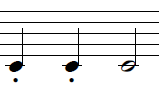
  • The first six notes. I played them and had the student tell me what finger numbers I used and then play it back.
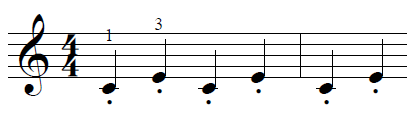
step1

  • The next four notes. I slowed it down so they could call out the finger numbers as we went (4-3-2-1). We pointed out that this is just a scale, which all of them have done. Then they played it back.

step2

  • The main theme. I played steps 1 and 2 together in time. They played it back.

step3

  • The variation on the main theme. We have done motifs before, so we talked about how our ears like repetition. The next phrase is the same motif that we have already learned. We just need to slide our hand down one note and play it again. (This is not necessarily the fingering I would use if I were playing it myself, but it is the easiest to remember when you are learning by rote.) After learning this step, we played everything we knew so far. We are now half way through the song.

step4

  • The third phrase is another variation on the theme. We slide our hands back up to C position, so we think we’re going back to the beginning, but at the end there’s a surprise. Again, we played everything we knew.

step5

  • After the surprise, we get to have the same scale that we skipped at the end of the last phrase.

step2

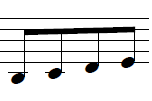
  • Except we keep going past the C and then come back up to an E. Here I fingered it differently, depending on the student. For beginners, they brought up their left hand to play the B. The more advanced students did a 2nd finger cross over. This was the hardest step for everyone.
step7

  • The very easy grand finale.

step8


For some of my students, this took all the time we had. For others, we had time left over, so we:

  • Played it as a duet. I accompanied.
  • Played it with different dynamics.
  • Played it with different speeds.
  • Made it minor.
  • Transposed.

If you’d like to see the entire song together, check out Rakes of Mallow here. Happy St. Patrick’s Day!


clover-445255_1920

The Sight Reading Dragon

Sight reading is an important skill, but practicing it is inherently boring for most students. Anything to make it more interesting is a welcome relief. In Chinese culture, seeing a dragon is a sign of good luck, something that is definitely helpful when you are trying to sightread. So to celebrate Chinese New Year this week, we present the Sight Reading Dragon.

What You Need:

  • A paper Chinese dragon head.
  • Strips of different colored paper
  • Stapler
  • A selection of sight reading material.
    • I find that picking music that is two levels behind their current level usually works. For the students in the first level, I just use a different series, go back as far as I can in the book to the easier pieces and, if necessary, break it up into one measure at a time.

Setup:

  • Loop one strip of paper, staple it closed and staple, tape, or glue or glue it to the back of the dragon’s head. This is necessary to get the paper chain started.

How to Play:

  • This is a studio-wide game, it will not be complete until all students have had their lesson for the week.
  • For every measure or section the students correctly sight read, they earn one strip of paper to add to the paper chain.
  • The goal is to make our brightly colored dragon as long as possible. I’ll be leaving mine up for a week so that everyone can see how long it grew.

Variations

  • For some students, I made it more competitive. I told them what the highest number of strips earned was and challenged them to beat that number. I didn’t do this with everyone, for the obvious reason that as a competition it’s totally unfair. They didn’t all get the same amount of time, some of them are beginning readers, some of them had longer sight reading selections, etc. But for some kids, the desire to win kept them going.
20180223_080933
The Sight Reading Dragon for Chinese New Year


Valentine Rhythm Dictation

Among my students, Valentine’s Day is controversial. Their reaction ranges from love to hate, with most hovering around total indifference. Fortunately, there is a way to make a Valentine’s activity that appeals to all of the above because the poems range from the traditionally sweet, through the silly surprising, down to the frankly insulting. I used this activity with all my students of all levels. The only difference was that the more advanced students could do it faster and with less help.

What You Need:

Setup:

  • None

How to Play:

  • Show the student all the Valentine poems so they can pick their favorite.
  • Determine the time signature.
    • I do this by telling them I’m going to clap and say the first measure (“Roses are”). Once they figure out that it’s in 3/4 time, they can write that before the first word of the poem.
  • Draw the first bar line.
    • Since I’ve already told them that the first measure ends after the word “are,” they need a bar line there.
  • Draw the first three notes above the first three syllables.
    • Repeat counting and saying the first measure. Some students may need a few hints to realize that each of those syllables gets a quarter note.
  • Finish the first line.
    • Count and say the entire first line. I made the final word a dotted half note. Obviously, alternate rhythms are possible, but the main point is not what the rhythm is, but whether the student can identify and write whatever rhythm you do.
  • Dictate the second line.
    • I did it as a whole line now that they have the idea of what to do.
    • Point out that the rhythm between first and second lines are exactly the same. That is normal and expected in this type of poetry. In music, it would be called a rhythmic motif.
  • Repeat the process for the third and fourth lines. The rhythms here will not be the same.
  • Have the student say and clap the whole poem in rhythm.
  • If there is still time, move to the piano and compose a song. The notes can be any note in C major (all the white keys). The rhythm should be the rhythm they wrote down.

Variations:

  • To make it easier, you can put in all the bar lines and time signature first, and do only one measure at a time.
  • To make it harder, don’t use the natural speaking rhythm. Syncopation or other unexpected rhythms usually go over well.
  • To make it longer, have the student change the rhythm after having written down yours.
  • To review the rhythms again afterwards, use percussion instruments to play it.


20180217_081417


Christmas Gift (How to Drill Anything)

‘Tis the season. I used this for sight reading, but it could be used for pretty much anything.

What you need:

  • Cards for whatever you want to drill
  • A game piece (I used Christmas ornaments)
  • Dice
  • A box or basket filled with a Christmas gift
    • I used leftover Halloween candy because I’m desperate to get rid of it.
    • I typically don’t like giving out food. You could also use party favors, erasers, printable Christmas jokes, whatever.

Setup:

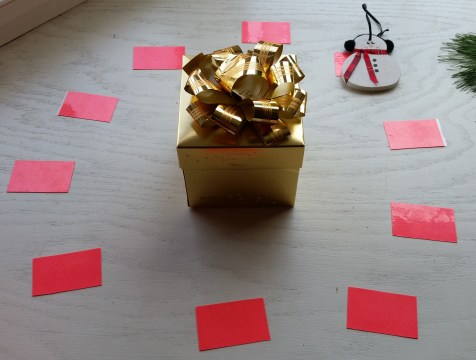
  • Put your flashcards face down in a circle around the box.

How to Play:

  • Place the game piece on any random flashcard. The student rolls the dice and moves the piece that many flashcards ahead.
  • Remove the flashcard the student lands on. They should play (or answer) that flashcard.
  • Roll again and repeat. Since you are steadily removing flashcards, the circle will get smaller and smaller.
  • The game ends when all the flashcards have been removed. The student can choose one gift out of the box as a reward.


20171215_102318


Dreidel (Music Twist)

Yesterday was the first day of Hanukkah. None of my students are Jewish (nor am I), so I thought it was unlikely that any of them had ever played dreidel before (nor had I). My total knowledge of the game comes from My Jewish Learning. We used it to drill rhythms, but as always, it is easily modifiable to drill anything else.

What you need:

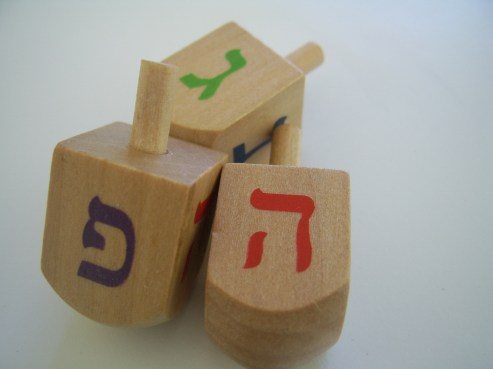
  • A dreidel.
    • These are not expensive. Think Oriental Trading Company, Amazon, etc.
  • Cards with whatever you want to drill. I used rhythm cards.
  • Game tokens of any kind.
    • Mine are from the game Reversi, but you could also use pennies, pencil erasers, small chocolates, whatever.
  • Paper and pencil (optional)

Setup:

  • Distribute tokens evenly between the players. I went with six each, but the actual amount doesn’t matter much. Add some to a center pile as well. I put four in.

How to Play:

  • The first player spins the dreidel. There are four possible outcomes:
    • ש – The player adds a token to the center pile, and count and clap a rhythm on from the stack of flashcards.
    • ח – The player gets half the tokens in the center pile and must invent a rhythm, write it out, and count and clap it.
    • ב – The player gets all the tokens in the center pile and must write out a rhythm that the other player claps.
    • נ – The player does nothing.
  • When the lesson time is over, the person with the most tokens wins.


If you thought through the statistics, you’ll have noticed that the odds are overwhelmingly in favor of having an empty center pile. Plus it’s all random chance, and I always like to make sure my students win, so here are a few tips:

  • Sometimes I make a mistake in my counting and clapping. If the student can catch me and do it right, they get the tokens I was supposed to collect. If I was supposed to add a token to the pile, I have to add double. I used this strategically whenever I was supposed to get a fair number of tokens.
  • When the center pile has been empty for a couple of turns, it gets boring. A couple of times, I just told the student I was going to cheat and add a few more tokens to the center pile. I did not tell them that I only did that when it was their turn. That increases the likelihood that they end up with those tokens, not me.


dreidels-20347_1920