Blog

Body Percussion Tempo Challenge

Body Percussion Tempo Challenge
A lesson activity for practicing different tempos

Often when a student is struggling with a phrase or measure, I’ll suggest that we play it slower. My students nod and say okay. Then they play it again at exactly the same speed. They often really don’t seem capable of changing whatever their default speed is. So this week we are working on tempo changes.

What You Need:

Setup:

  • None

How to Play:

  • Stand up in front of the piano. Have the student pick four of the body percussion cards and lay them out in any order on the music stand. I put a ruler afterwards to represent a repeat sign.
  • Each card gets one beat, so we now have a measure of quarter notes in 4/4 time with a repeat sign. For example, the layout might be: Clap, Stamp, Stamp, Cluck. Practice the rhythm a few times.
  • The metronome app on my phone allows me to tap a beat and have it give me the metronome marking, so I tell the kids we are going to find out what their default preferred tempo is. They count, I tap, and the metronome gives us our start speed.
  • Working together, try to do the body percussion measures at that speed.
  • Draw a random tempo strip. Try it at that speed. Is it faster or slower than the student’s default speed? (If they get Presto and can’t manage it, that’s okay. It can be a good lesson in how important it is to learn things at a slower tempo before we try to take it fast.)
  • Continue drawing tempo strips until all are done. Which tempos are easiest? Which are hardest? How does it feel to switch between them?
  • If there is still time, try different tempos or working your way back up to presto. Many times a student who can’t do presto when they first draw that strip, will be able to do it if you work your way up slowly.

Variations:

  • To make it easier, don’t use the rest cards. Also, you can require each card to come in a group of two identical cards, so that you end up with something like: Clap, Clap, Stomp, Stomp. It is easier than having four separate actions in the measure.
  • To make it harder, create two different measures. Also, gradually increase the speed beyond presto.


Pre-Recital Self Assessment

Our spring recital was yesterday, so last week’s lessons were the last chance to get some feedback before the big event. I always like to record the kids so they can watch their own playing afterwards. This time we watched the recording and then used Pianimation’s Smile-O-Meter for a self-assessment, which I highly recommend, especially when used with a recording.

I find that the kids often have no idea how well they’ve done right after they’ve played. It helps to have watched it all the way through, and then break things down into notes, rhythm, details, and technique. I also find that some kids automatically think they were wonderful and some kids automatically think they were terrible. This is a good way to talk about bringing both those opinions closer to reality.

Question and Answer Improv

Some of my students create beautiful melodies by instinct. Most don’t. I’ve been stymied in my attempts to teach them improv, not because they can’t grasp what the left hand needs to do, but because they can’t grasp what the right hand needs to do. That was the part I thought would be obvious, but I was wrong. I’ve been working on melodies with them for months now and today we had a breakthrough with this activity.
Question and Answer Improv Activity
A coin-flipping lesson activity

What You Need:

  • A coin (any kind)
    • I used a silver dollar because an unfamiliar coin generates interest
  • One die to generate a key signature
    • I used a blank die and wrote on the sides: C, G, D, F, Am, and ?
    • It would work just as well to use a regular die and assign each number one of those key signatures.

Setup:

  • None

Explanation (to the student):

  • Today we are using a technique that many composers have used, called Question and Answer Phrasing.
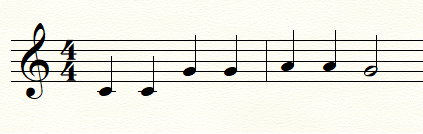
  • One of the most famous examples is in “Twinkle, Twinkle Little Star.” The first part is the question:

twinkle 1

  • We can’t stop here because we didn’t end on the home note (C). It leaves us wondering what comes next.
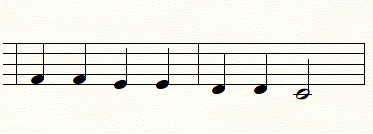
  • What comes next is the answer:

twinkle 2

  • The answer does end on the home note (C), but that’s not the only thing that makes it a good answer phrase.
  • Note that the question is exactly two measures long. The answer is also exactly two measures long.
  • Note that the question uses quarter notes and half notes and it likes to repeat the quarter notes.
  • The answer continues that rhythmic pattern and the use of repeating notes. This is what makes it a good answer. If we didn’t do anything like that, it would be as if I asked you, “What’s 7 plus 2?” and you said, “Sharks!” That answer doesn’t go with that question.
  • We want our answer phrases to go with the questions, so they need to be the same length and use similar rhythms, articulation, or note patterns. Above all they need to end on the home note.

How to Play:

  • The first person flips the coin. If it lands on heads, the flipper should then improv a question phrase. The other person will then improv an answer. If it lands on tails, the other person should improv a question phrase, and the flipper should then improv the answer.
    • The question should:
      • Use C major. Do not end on C.
      • It should have definite rhythm and either one full measure, or two full measures.
    • The answer should:
      • End on C.
      • Be the same length as the question and fit in stylistically. Be as lenient as you want here.
  • Repeat with the other player flipping the coin.
  • When the student has the hang of it, you can add a wrinkle. Use the die to determine what key signature the melody should be in. (Even some of my younger students can handle this. Just show them where to put their hands and tell them to stick to just the five notes their fingers are on.)


Variations:

  • To make it easier:
    • Stick with one measure only and stay in C major.
    • Count out loud if you need to.
  • To make it harder:
    • Change the time signature.
    • Make the phrases longer.
    • Require them to move beyond a five finger pattern.