Blog

Zap It (Rhythm Review)

This is my spin on a traditional educational game listed on many places on the Internet. I use it for rhythm, but the principal can be used for anything. My version is a little different. It’s for two players only (teacher vs. student). The kids love beating me, and they have yet to point out that they always win. It takes a bit of prep work to create the game in the first place, but absolutely no setup during or right before each lesson.

What You Need:

  • Popsicle or craft sticks with rhythms (or whatever you’re drilling) written on one end
    • You can buy different colors or sizes to make different levels of rhythms.
    • All the rhythms are two measures long. I have mixed time signatures.
  • A few sticks with “Zap It!” written on one end
  • (Optional) A few sticks with “Instrument” written on one end, plus a selection of percussion instruments
  • An opaque container to hold your sticks

Setup:

  • None

How to Play:

  • The student draws a stick. She identifies the time signature and then counts and claps that rhythm. If she gets it right, she keeps the stick.
    • In reality, I have the kids do it again until they get it right, so they always keep the stick.
  • As teacher, I draw a stick. I identify the time signature and then count and clap the rhythm. If I get it right, I keep the stick. If the student catches me getting it wrong, the student gets a chance to do it right. If the student gets it right, she can keep the stick instead of me.
    • I do this strategically, not only to make sure they are paying attention during my turn, but also to ensure they always win the game.
  • Alternate turns until someone draws a Zap It! stick. At that point, everyone counts their sticks. Whoever has the most sticks is the winner.
  • If someone draws an Instrument stick, they draw another stick to get a rhythm and can choose a percussion instrument to use instead of clapping. They keep both sticks at the end of the turn.
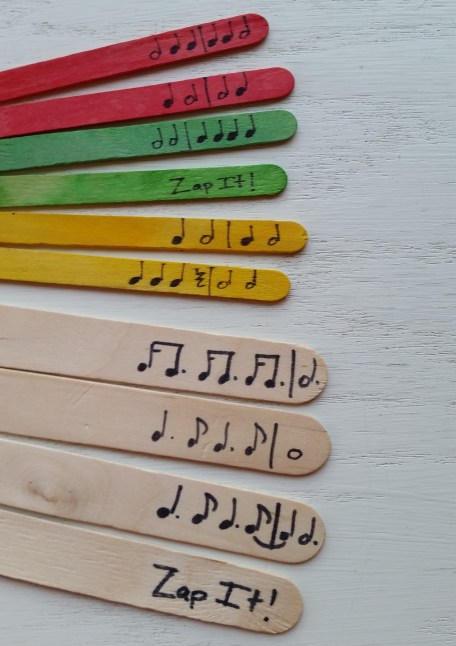
Zap It! (Rhythm Review)

Beat Your Score/Build Your Dream (How to Drill Anything)

We practiced notes on the staff this week with this method, but you can use it to drill anything you have a set of flashcards for.

What You Need

  • Set of flashcards
  • Timer
  • Blocks or Legos or any other building toy (optional)

Setup

  • None

How to Play

  • Set the timer. I chose a 30 second time limit.
  • While the timer is running, flip the cards for the student one at a time. When the timer goes off, count the number of cards answered correctly.
  • If you are using the blocks, they’ve earned that number of blocks to begin building whatever they want.
    • Some of my students are old enough to feel that blocks are beneath them. That’s fine.
    • I only give them a short time to build, so I discourage risky building strategies. If it falls, we go on anyway. They’ll have another opportunity later.
  • Set the timer again. The point on the second round is to see if you can beat your first score. Whether they do or not, they can add that many blocks to their structure.
  • Repeat as many times as you want.

Variations

  • To make it easier, limit the flashcards. For example, use only C position notes or only bass clef notes.
  • To make it harder, add more flashcards into the stack. If you’re drilling notes, require them to both name the note and play it on the piano.
building-blocks-717309_1920
Beat Your Score/Build Your Dream (How to Drill Anything)


Spot the Rhythm

It’s rhythm week here, and this activity evolved with the week. In it’s final incarnation, here’s how it worked.

What You Need:

  • A set of one measure rhythm cards
  • percussion instruments (optional)

Setup:

  • Lay out six to twelve cards, face up

How to Play:

This game is a series of challenges. Each step is a little harder than the one before. The goal is to get through as many challenges as you can before the lesson ends.

  1. The student chooses a card, but does not remove it, point to it, or indicate it in any way. He should count a preparatory measure out loud to establish the beat. Then he should clap the measure (not counting out loud). Hopefully, the teacher will be able to identify which measure the student chose.
  2. Switch parts.
  3. Repeat challenge one using a percussion instrument instead of clapping. If you’re not using percussion instruments, just clap.
  4. Switch parts and percussion instruments.
  5. Return to clapping. This time choose two measures. Again, count a preparatory measure. Then clap the two measures in succession. Hopefully, the teacher can identify both measures.
  6. Switch parts. Many of my students found one measure easy to identify, but two measures very difficult. Repeat the clapping as many times as necessary to ensure success.
  7. Add in the percussion instrument.
  8. Switch parts and percussion instruments.
  9. Return to clapping. This time choose three measures.
  10. Etc.


Variations:

  • To make it easier:
    • Limit the rhythms to quarter notes, half notes, and whole notes.
    • Put out fewer cards to choose from.
  • To make it harder:
    • Include eighths, sixteenths, triplets, etc.
    • Put out more cards to choose from.
    • Start with two or three measures to begin with. Or go on up to six or seven measures.
    • Put out mixed time signatures so they may have to switch in the middle.


drum-924348_1920
Spot the Rhythm

Play Like an Animal (Improv)

This is a very short improv exercise that most of my students love. You can repeat it as many times as you want, so it’s a good time filler regardless of how much time you have.

What You Need:

  • Nothing

Setup:

  • None

How to Play:

  • Ask the student to choose an animal. Any animal will work, though it’s most fun if there is something distinctive about that animal. Kangaroos, cheetahs, eels, and turtles are all good choices.
  • Talk about what musical characteristics describe that animal.
    • Fast or slow?
    • Loud or quiet?
    • Legato or staccato?
    • Major or minor?
  • Play an improv duet together about that animal.
    • I usually stick to C major or A minor for this because we’re working on musicality more than we are working on key signatures.
    • I just play the primary chords in whatever style suits the animal.
    • The student makes up a melody to go with it.
    • The student should end on the tonic.
  • Afterwards, be sure to give some compliments about it. Did it have rhythm? Did it stick within the key signature? Did it have a motif? Etc.
  • If you repeat this, try picking an animal that is very different.
giraffe-2222908_1920
Play Like an Animal! (Piano Improv Exercise)